
Artfields installation artist: Jarod Charzewski

Jarod Charzewski
ArtFields Location: J. S. McClam Livery Stable
jarodcharzewski.com
Jarod Charzewski’s ephemeral, site-specific installations reference his lifelong interest in themes of geology and landscape, mankind’s influence on nature, and the balance between urban and rural environments. Originally from Winnipeg in Manitoba, Canada, Charzewski studied art at the University of Manitoba and later received his MFA at the University of Minnesota, before moving to Charleston in 2006 to begin teaching sculpture at College of Charleston. Charzewski claims the word “artist” is a relatively new way of thinking about himself. He says he’s always just viewed himself as a person “making things”—a tinkerer with an insatiable curiosity, always drawing, always building. Using items garnered primarily from Goodwill and Craigslist, Charzewski plans to transform his “epically proportioned” site at ArtFields into a kind of shanty town, using ubiquitous glass flower vases and plastic children’s play sets, but he imagines the overall effect of so many thousands of objects clustered together will create something altogether bigger. “Every new space and installation is an experiment,” he says. “I never want to do the same thing twice.”
AM: Where are you from, originally? And what can you tell us about your background and what led you to become a professional artist?
JC: I grew up in Winnipeg, Manitoba – it’s in the very center of Canada. It’s a really healthy art environment there, but there’s really no “art market” so a lot of artists came out of there doing what they wanted; not worrying about selling things or about marketing their art, because there was just no chance of selling it. So it’s a liberating thing – focusing on what you want to do versus making some money. That’s why a lot of people from there are doing very unconventional things – a lot of video production, installation work – less marketable art, less commercial art.
I came to Charleston in the fall of 2006 because I was offered a job at the College of Charleston [CofC], where I teach in the sculpture studio – it’s great – it’s a really huge facility – I could liquefy a truck in there if I wanted to!
The word “artist” is fairly new to me, really. I was always just kind of making things. I was very much a tinkerer of objects and stuff, always curious about how things worked and taking them apart and using them for other things. I basically tried to inconvenience my family as much as possible by saying, “No one can using the dining table for a while, ‘cause my projects and drawings are on there!” I used to carve out a little section of the house for myself and did what must have appeared to be odd things in there, but I was encouraged (or tolerated!) by my family and it was great living in a supportive environment like that.
Then, where I went to undergrad, at the University of Manitoba, I was hired as a TA and studio manager right after school. From there, I went to graduate school at the University of Minnesota and I taught there afterwards and later in St. Paul, MN; and then CofC offered me the position here and this is where I landed.
Can you talk a little bit about your installation work?
JC: I remember finding out – I must have been a teenager – that my old elementary school was built on top of a landfill site. There were all these sort of weird recreational hills around it, and I forget who told me, but it used to be a landfill. So I immediately started thinking about what it would be like to take a section of that earth and see the layers of things, of toys, of clothing. I always thought about that and wanted to do that piece – to take a section out of a landfill and see how things are layered and how they’re breaking down. It’s stuck with me; it really hit home.
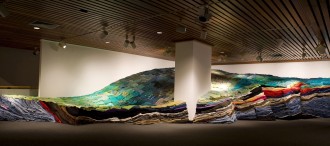
So, it really started off with this idea I had years ago – this whole thing about geology and sedimentary layers, and the history of the earth – that all evolved out of that single idea I had. I wanted to make a kind of topography out of stuff. But the thing is, I always wrote it off…see, I don’t want to buy and accumulate that much stuff, even if I could get it cheaply. I’m the kind of guy who would just have that stuff FOREVER – I would never throw it away! Second of all, where would I put all of it? It was so impractical an idea and it could never resolve itself. And then this opportunity came in 2008 to do a show at the Halsey [The Halsey Institute of Contemporary Art at CofC] and suddenly I had the space – not a huge space, but more importantly I had the time. The gallery was closed all summer and mine was to be the first show in the fall, so I had all summer to work in there. So I thought, if that piece is going to happen, it was going to have to be now. And I kept weighing my options about where to get the stuff…and ultimately I went to Goodwill and specifically to the Goodwill outlet store where the stuff that hasn’t sold gets offered for sale by the pound. I saw this large quantity of clothing and children’s toys, beat up furniture – a lot of this stuff is just garbage, literally, that gets donated. But, I thought to myself, “This is it. This could be my opportunity here!” But I still didn’t want to buy all of this stuff, even if I could get it cheap. So I spoke with them and told them what I wanted to do and I met this one guy there and he said, “Come with me a sec.” So I followed him back to this vast warehouse and he told me that the warehouse was emptied and filled once a day with stuff they couldn’t sell – it was huge! The guy I was with really seemed to get what I wanted to do and he told me I could use the stuff on the condition that once I was finished with it, it had to come back to Goodwill because they can’t be seen to be a company that gives things away, otherwise people won’t buy the stuff. So I finally had all the pieces – the space, the time, and the stuff. And my time [at the Halsey gallery] acted like a residency, where I could set up the piece and tear it down – it was a lot of trial and error and it was a disaster in there for a while – it was such a great experience! Every artist should have the opportunity to experiment on such a large scale.
 AM: What made you get involved with ArtFields in its inaugural year? And what can you tell us, if anything, about the installation you’ll be creating there?
JC: I think it’s a great idea and something I’ve always spoken about. I say things like: “Art will save the world!” And it’s true you know. Like back in 2008 or so when all those buildings were boarded up along Upper King [Street] – I mean it was the artists who were doing installations in those spaces. When businesses move out, artists take over – and then people come to see the art and the area gets a boost. I recently did a piece at ArtPrize in Grand Rapids, MI. And just listening to them and what ArtPrize has done for their economy, done for their community, and their city is really a miracle. They initially had a big backer, a family, and with that they were able to draw some really good artists and now that it’s established, there’s lots of discussion around the event all the time; it’s healthy for a community to be having that dialogue. And I think it can work for ArtFields as well – it could revitalize things, bring some attention to those beautiful buildings there, and get people really moving through the community again.
The work I’m planning to create for ArtFields is along the same lines [as my previous work]. Although, I’ve branched out to other resources, like Craigslist and done these mass emails requesting stuff. I’ve been collecting up about a couple thousand of those ubiquitous glass vases you get from flower shops, and also children’s toys like those Little Tikes Play Castle things. I’ve accumulated a lot of that material and I envision creating a kind shantytown out of those play structures. My site at ArtFields is in the Stables – it’s pretty raw space and there’s great lighting and a beautiful floor – and it’s just huge. My goal is to fill the space appropriately, but it’s always an experiment – I don’t ever want to do the same thing twice. I’ve also been looking at a lot of work lately, like the artist Tara Donovan. She uses pencils, but by the thousands. And when you cluster things like that, in that quantity, they change. It’s not about pencils anymore; it’s about a landscape. And with these glass vases and plastic play sets I’m going to be using, it will be a large scale piece, but I want it to be intentional and to become something organic and natural-feeling somehow.
What are you trying to communicate with your work?
JC: I think, generally, recycle and reuse – it’s about the life cycle of things.
AM: Who or what has been inspirational to you lately?
JC: I mentioned Tara Donovan and I’ve known about her for a while. And I think my son has been inspiring me – he’s going to be two in May and he’s my biggest critic!….But seriously, the kind of unnatural accumulation of toys in our house that people buy for him – all that plastic affects things and I think about that and the lifespan of things and what we’ll do with them after he’s finished playing with them.
AM: What place would you like to travel to or explore next?
JC: I just applied for a residency at the Grand Canyon (I’m probably jinxing myself by saying it). Some people might think that’s counterproductive, that I should be going for bigger residencies, in cities where I can get more exposure. But I just want to be surrounded by it, by those sedimentary layers, and to be secluded for a bit – it just appeals to me more. You know, I’m really fond of places like that – I planted trees for a while after high school, in really secluded parts of Canada and I loved it. I love the interaction between mankind and the landscape – even the kind of tragedies like clear-cutting – I’m fascinated by that, by how we change our landscapes and our impact on the land.
AM: Is there anything that people might be surprised to know about you?
JC: Yes! Well, it’s a bit of a story…. Let’s see, it must have been about 1994. I was in a car accident in Winnipeg. I used to be a limo driver, and I was on my way to pick up a bride when I got rear-ended by a Corrections vehicle transporting a prisoner of some sort. It was just a little bump, no big deal really; everyone was fine. But, because they were official and transporting this prisoner, the Canadian government made me go through this series of health checks for insurance purposes, even though I was perfectly OK and I wasn’t planning on suing anybody. Anyway, they just kept hounding me to go because it was their policy. So, I finally just went to see this doctor and then to this chiropractor. So first [the chiropractor] x-rays my back and a few minutes later, I see this guy coming through the door and his eyes are huge, they’re bugged out at me, right. And I’m a little worried at this, so I say, “What?!” And he proceeds to tell me that I have the largest back vertebrae he’s ever seen. He holds his hands up to show me and says my back is like a tree trunk; it’s massive. So there’s that – apparently, I have the hugest, freakiest spinal column ever.
Words: Jessica Dyer





Comments (0)
No comments yet
The comments are closed.