Come Quickly, Have Found Heaven
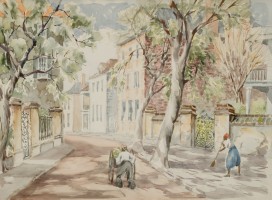
At the Bend, Church Street, n.d. By Alfred Hutty (American,1877 – 1954) Watercolor on paper. Courtesy of Private Collection
Charleston has long been a mecca for artists of all kinds, and over time, has experienced some lulls as well as significant periods of booming creativity. After the Civil War and Reconstruction, Charleston was a mere shell of its former Antebellum glory. During the time between the two World Wars however, there was a resurgence of culture led by literary and visual artists, known as the Charleston Renaissance (spanning roughly 1915-1940). Many arts leaders believe we are going through a similar renaissance today. This winter, the Gibbes Museum of Art features two exemplary “renaissance” artists: Alfred Hutty of the Charleston Renaissance and Jill Hooper of the current day renaissance.
Hutty was a transplant from up North. As so many before and since, he was romanced by and fell in love with Charleston. Born in Grand Haven, Michigan, Hutty was an active member of the Woodstock colony of artists in upstate New York when he first found the Holy City in February 1920. The mythologized story goes that he telegraphed his wife Bess, “come quickly, have found heaven,” and they maintained a home in Charleston until his death in 1954.
Hutty was already an accomplished painter, having honed his skills at the St. Louis School of Art and the Woodstock Art Students League, under the tutelage of landscape painter Birge Harrison. In Charleston, circa 1921, he began etching, and over the next decade established a solid reputation as a printmaker. Two of Hutty’s dry points (a difficult technique that produced a very limited number of impressions) were included in American Etchers Volume II, published in 1929.
The current exhibit, The Art of Alfred Hutty: Woodstock to Charleston, will hang at the Gibbes Museum from January 20 – April 22, 2012, and then travel to Greenville County Museum of Art in Greenville, SC and Morris Museum of Art in Augusta, GA. This career retrospective will be on view in the museum’s Main Gallery and is accompanied by a book and catalog raisonne.
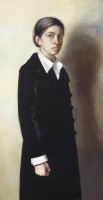
Self Portrait by Jill Hooper. Collection of the Gibbes Museum of Art
From New York to Charleston to Florence, Italy and back, classic realist painter Hooper seems to also have found heaven in Charleston. She studied studio art at the College of Charleston, apprenticed for many years with the famed D. Jeffrey Mims and later in Florence with the renowned Charles Cecil, and more recently with extremely accomplished painter Ben Long. She exhibits regularly alongside her mentors at Ann Long Fine Art on Broad Street.
Jill Hooper: Contemporary Realist marks her second solo museum show, and to be exhibited alongside a respected artist such as Hutty is a remarkable honor. Not only is Hooper the youngest painter in the Gibbes Museum of Art’s permanent collection, she is a founding member of Society 1858, the Gibbes’ young professional auxiliary group. If you happen to be there on the right day, she sometimes volunteers as a docent, leading visitors on tours around the museum.
Hooper’s studio is what you’d imagine a perfect artist’s studio to be like. In a second floor space with perfect Northern light in downtown Charleston, easels are set up, chaise lounges and beautifully woven throws stand ready for the next model. Primed canvases of varying sizes are stacked against the wall, waiting patiently for Hooper to apply her paints. There’s even a skylight, providing the natural light she prefers to work by.
The subjects and elements in each painting are carefully, thoughtfully selected. Hooper seems to gravitate towards vulnerable or contemplative moments. One subject asked the artist, “Jill, why do you always accentuate my flaws?” Hooper replied, “because, my dear, that’s the most beautiful part.”
words: Stacy Huggins
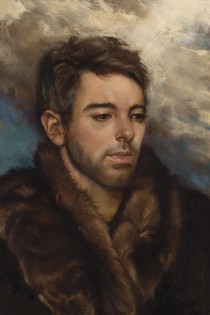
Jacob By Jill Hooper (American, b. 1970) Oil on linen on panel, 20 ½ x 13 ¾ inches. Courtesy of Ann Long Fine Art





Comments (0)
No comments yet